
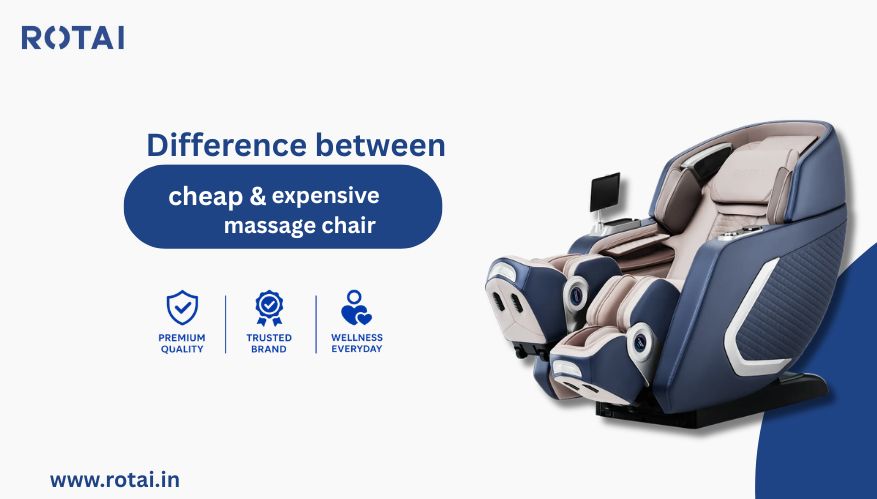
If you’ve started shopping for a massage chair, you’ve probably noticed the price range is enormous; some chairs cost ₹50,000–₹100,000, while others go well beyond ₹200,000. At first glance, they can look similar in photos: same recliner shape, similar buttons, similar promises of “full body relaxation.” So why the massive price gap?
The honest answer is that cheap and premium massage chairs are built on completely different engineering philosophies. Budget chairs are designed to give you a massage. Premium chairs are designed to give you a massage, one that’s mapped to your spine, your height, and your specific pain points using AI body scanning, 3D/4D/5D roller technology, and intelligent customization.
In this guide, we’ll break down exactly where the money goes, so you can decide whether a budget chair is enough for your needs or whether it’s worth investing in a premium model.
1. Massage Mechanism & Movement
Cheap Chairs: The rollers typically move along a rigid, two-dimensional grid, up/down and left/right. You can usually increase or decrease the speed, but you can’t control how deep the rollers press into your muscles. The pressure stays mostly fixed regardless of the program you choose, which means the massage often feels generic rather than therapeutic.
Expensive Chairs: Premium models use 3D, 4D, or even 5D mechanisms. Unlike basic 2D rollers, these can physically push forward into the muscle for genuine deep-tissue pressure and adjust speed and depth dynamically, closer to how a human therapist’s hands actually work. Many premium chairs offer an extended reach and an adjustable width, allowing the rollers to follow your body’s natural contours instead of just sliding along a flat track.
This is also where supporting categories like the Rovo Walking Massage Chair and 4D Luxury Massage Chair come in. These advanced mechanisms are specifically engineered to mimic real stretching and walking motions, something a basic 2D roller simply cannot replicate.
2. Body Scanning & Customization
Cheap Chairs: Most budget chairs use a “one-size-fits-all” approach. There’s no body scanning, so if the rollers don’t naturally align with your spine or neck, which is common if you’re shorter, taller, or broader than average, you miss out on the intended therapeutic benefit entirely. You might end up with rollers pressing on bone instead of muscle.
Expensive Chairs: Premium chairs feature optical or intelligent sensors that scan your height, shoulder width, and spinal curve before the massage even begins, then choreograph a custom massage routine around your body. This is precisely the kind of AI intelligent sensing found in Rotai’s higher-end lineup, where the chair maps your body shape before delivering a session so two people of different heights using the same chair both get an accurate, targeted massage rather than a generic one.
3. Track Length & Reach
Cheap Chairs: Budget chairs often rely on basic “S-tracks,” which are limited to the length of your spine. This means your massage essentially stops at your lower back; your hips, glutes, and thighs are left out.
Expensive Chairs: Premium models use “SL-Tracks” (which extend further down under the glutes and thighs) or full “L-Tracks,” ensuring consistent coverage from your neck all the way down to your hamstrings. Top-tier chairs often stretch well over 1,200 mm, covering head to legs for genuine full spinal alignment instead of stopping halfway.
This is why full-body massage chairs are increasingly the standard people search for; buyers have realized that a short track simply can’t deliver a true full-body experience, no matter how good the rollers are.
4. Airbags, Heat & Extra Features
Cheap Chairs: Budget models typically come with fewer airbags (usually used only for the arms and calves) and basic heating, often limited to the lower back region. Controls tend to be simple physical buttons with a handful of preset programs.
Expensive Chairs: Premium chairs offer full-body air compression with significantly more airbags, multi-zone heating across the waist, back, and legs, zero-gravity reclining, Bluetooth audio, and AI-guided programs that adapt in real time. Top models can pack 15+ wrap-around airbags, silicone alloy heating pads, a built-in Bluetooth speaker, and a touchscreen controller with voice command support.
5 .Build Quality & Reliability
Cheap Chairs: Budget massage chairs tend to use lower-grade plastic components and motors, which can result in a shorter lifespan and higher long-term maintenance costs. Many also come with limited warranty coverage, sometimes just 6 months to a year, and parts can be harder to source if something breaks down.
Expensive Chairs: Premium chairs are usually built with reinforced frames, fiberglass spring components, and higher-grade motors designed for years of daily use. They also tend to come with overheat protection, multiple safety sensors, and longer warranty periods that reflect the manufacturer’s confidence in the build. A well-built premium chair can realistically last 7 to 15 years with proper use and maintenance, compared to a budget chair that may need replacing within a few years.
Budget vs Premium: Quick Comparison
| Feature | Budget Massage Chair | Premium Massage Chair |
|---|---|---|
| Roller Mechanism | Fixed 2D rolling | 3D / 4D / 5D adaptive roller mechanism |
| Body Fit | One-size-fits-all design | AI body scanning & personalized customization |
| Airbags | Limited airbags with fewer massage zones | Full-body, multi-zone air compression system |
| Heating | Lower back heating only | Multi-zone heating with higher temperature range |
| Controls | Basic button controls | Touchscreen, voice control, mobile app & Bluetooth connectivity |
| Build Quality & Lifespan | Shorter lifespan with basic materials | Premium construction with 7–15 years of life (with proper maintenance) |
| Warranty | Limited warranty coverage | Extended warranty and better after-sales support |
Why an Affordable Massage Chair Doesn’t Have to Mean a Compromised One
Here’s the thing: “budget” and “low quality” aren’t always the same. The real risk with cheap massage chairs isn’t necessarily the price tag; it’s chairs that cut corners on the mechanism, track length, and body-fit technology to hit that price tag. If you want an affordable massage chair that still gives you genuine therapeutic value, the smarter move is to look for a chair that includes at least a few premium-tier features, a longer track, multiple airbags, and adjustable intensity, even if it doesn’t have every single AI feature of a flagship model.
This is exactly where a brand like Rotai fits in. Rather than forcing customers to choose between “cheap and basic” or “premium and expensive,” Rotai has built models across different price points that still carry forward core premium technology like SL-Tracks, zero-gravity positioning, and multi-program automation.
Frequently Asked Questions
Q1. Are expensive massage chairs really worth the extra cost?
Yes, for most regular users. Expensive massage chairs use 3D/4D/5D mechanisms, longer tracks, and body scanning that deliver a far more accurate, therapeutic massage compared to the fixed, generic motion of budget chairs.
Q2. Can a budget massage chair still be a good purchase?
It can be, as long as you check for a few non-negotiables: an adjustable-intensity mechanism, a reasonably long track, and at least basic heating and airbag coverage. Avoid chairs that offer only fixed-speed 2D rolling with no customization, as the therapeutic benefit will be minimal.
Q3. Is a premium massage chair suitable for office workers with back pain?
Yes. Most premium chairs are designed for people with long sitting hours and work-related stress, with programs targeting neck stiffness, shoulder knots, and lower back tension, along with zero-gravity recline that reduces spinal pressure.
Q4. How long does a good massage chair last?
A high-quality massage chair generally lasts between 7 and 15 years, depending on usage, maintenance, and build quality. Budget chairs with lower-grade components typically need replacement much sooner.
Q5. Can massage chairs be used daily?
Yes, most massage chairs, including Rotai models, are designed for daily use, with sessions typically recommended in the 15–30 minute range for relaxation and muscle recovery.
Final Thoughts
The difference between a cheap and an expensive massage chair isn’t just marketing ,it comes down to real engineering differences in roller technology, body tracking, track length, and build quality. A budget chair can still offer decent relaxation for occasional use, but if you’re dealing with ongoing back pain, poor posture from long work hours, or you simply want a chair that adapts to your body instead of the other way around, the extra investment in a premium mechanism pays off in both comfort and durability.
Whether you’re looking at a Rovo Walking Massage Chair for advanced stretching, a 4D Luxury Massage Chair for deep, dynamic pressure, a true Full Body Massage Chair for complete coverage, or simply an Affordable Massage Chair that doesn’t cut corners, it’s worth checking the mechanism, track length, and body-scanning features before you decide, not just the price tag.